

Areas of Expertise
Well-being
Pursuit of a more nuanced definition of well-being drives much of Dr. Colacchio’s research, including her foundational study with youth in foster care.
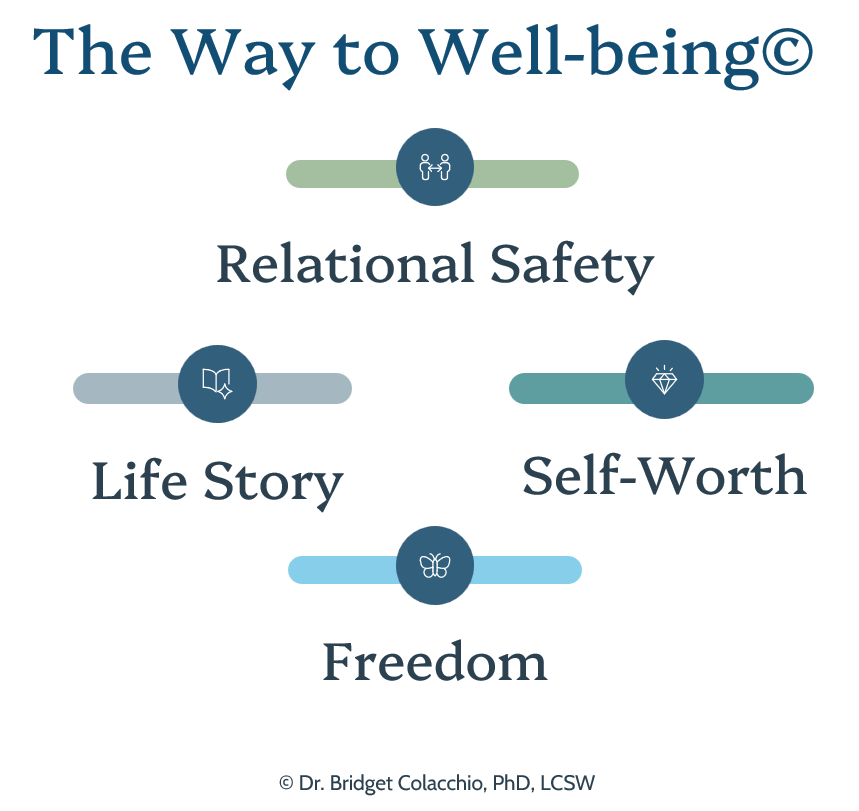
The Way to Well-being© framework is the core finding from that art-based, participatory action research project with young adults who experienced foster care. It illustrates how people can move from distress and ill-being to the worthiness and freedom of well-being by owning their full life story and nurturing relational safety©.
-
The central framework Dr. C created based on 20+ years of research, clinical, teaching, leadership and parenting experience is The Way to Well-being©. The framework describes the critical components of the journey toward well-being:
Radically accepting the whole true story of our lives and ourselves,
Cultivating relational safety©,
Embracing the embodied certainty of our intrinsic self-worth, and
Living into the freedom of a life where we express, connect, innovate, and savor with the 8 C’s*: calm, curiosity, clarity, confidence, compassion, courage, connection, and creativity.
See Dr. C’s full dissertation: The Way to Well-being
*The 8 C’s of the true Self are part of Dr. Richard C. Schwartz’ teaching and frameworks in Internal Family Systems (IFS). (See more about Dr. Schwartz and IFS.)
-
Read the article on The meaning and essence of child well-being according to child welfare professionals.
Co-authors: Julia Pryce & Gina Samuels
-
Listen to Dr. Colacchio’s conversation about the Way to Well-being© on the Illinois DCFS podcast.
Listen on Spotify.
Freedom
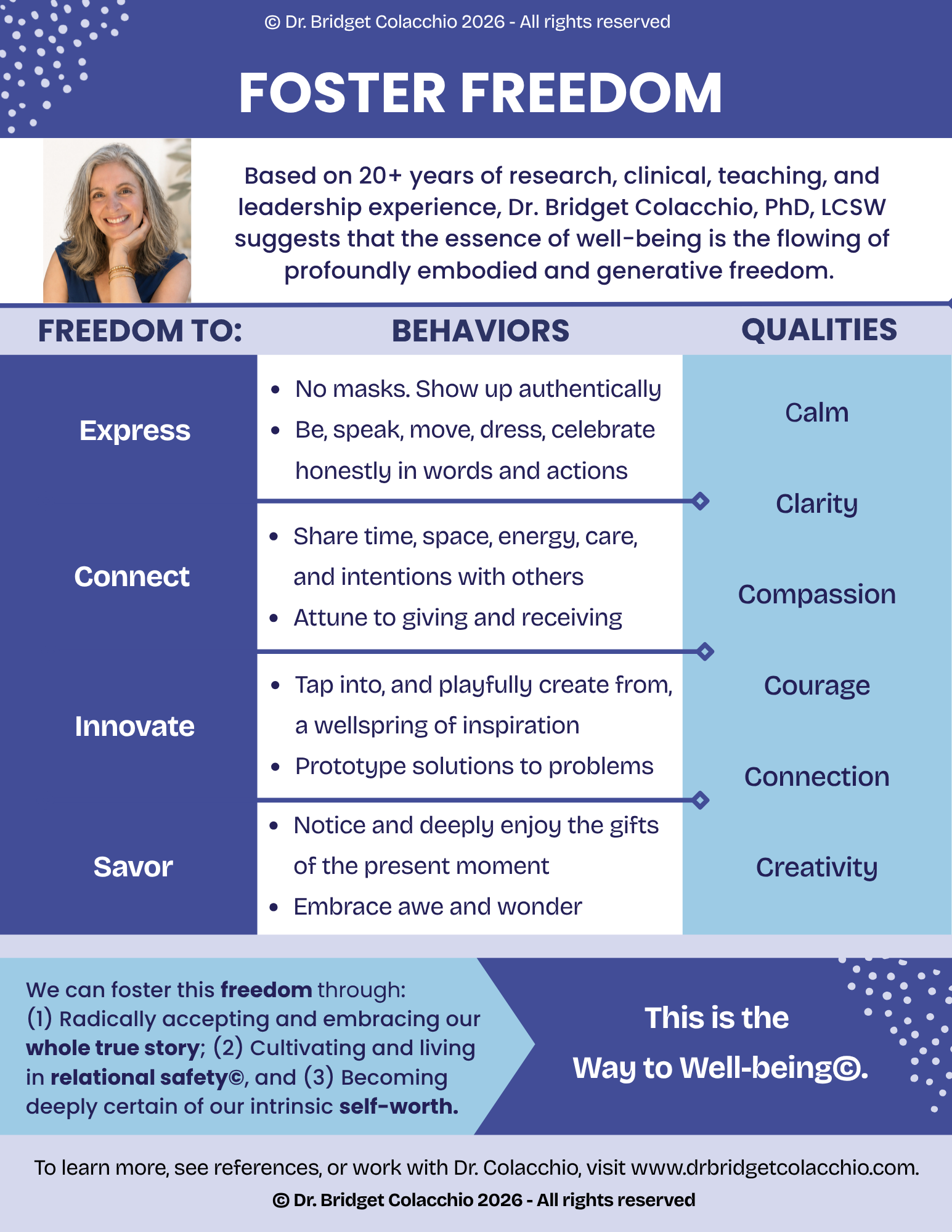
The essence and definition of true well-being is freedom. This work demonstrates that freedom is the contented, embodied ability to express, connect, innovate, and savor life from a place of clarity, confidence, courage, and creativity.
-
Learn how to foster freedom for yourself and others. If you do not feel free to enact the behaviors listed, take a look at how in touch you are with your whole, true story, whether their is safety in your relationships, and if you have embraced your self-worth. See the “Foster Freedom” infographic on this page.
-
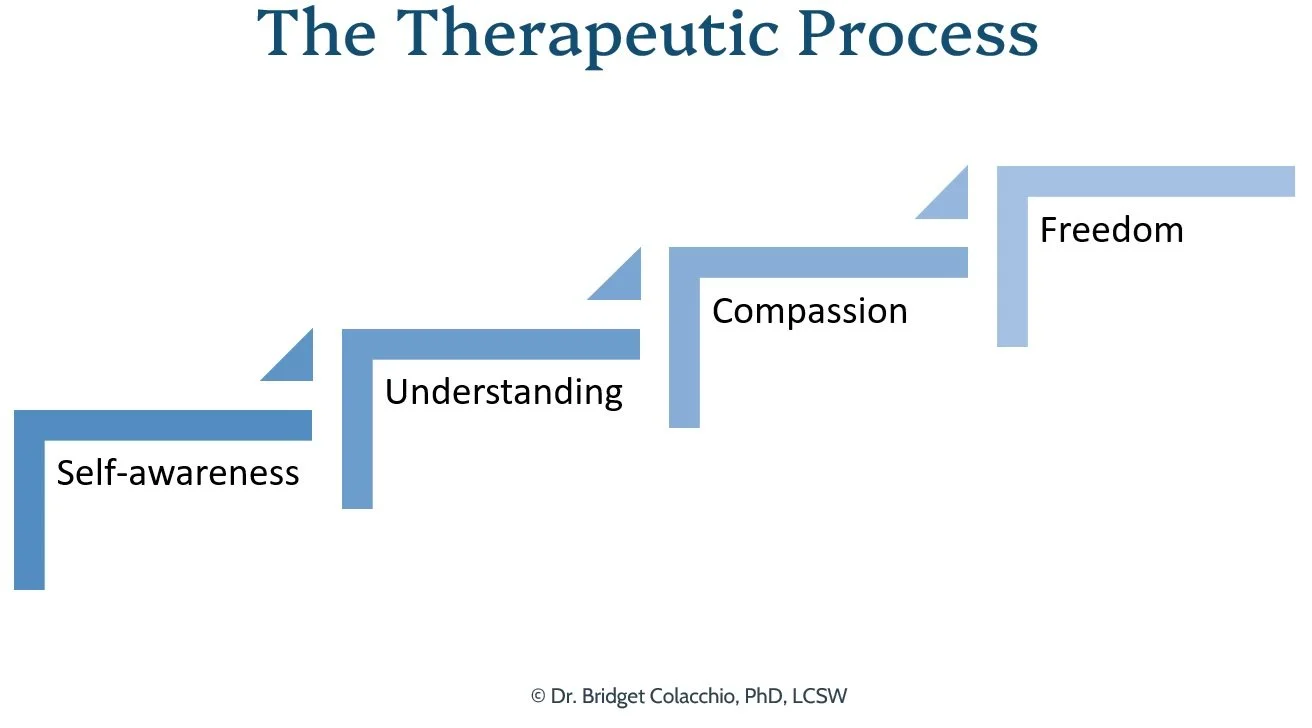
Dr. Colacchio created her very first conceptual framework in 2007 to describe the therapeutic process she was experiencing as a new clinician and also as a client.
This critical process includes these steps:
Develop skills and habits for self-awareness.
Cultivate understanding of why, how, where suffering came from and is reinforced.
Practice compassion for self and others.
Embrace the freedom from suffering and savor the awareness of a rich, full life of multi-dimensional experiences.
Without realizing it at the time, this was the start of centering freedom as the aim of her work.
-
In an art-based collective auto-ethnography, Dr. Colacchio and colleagues created and analyzed artwork as they uncovered how arts-based research (ABR) can offer a sense of deep authenticity, connection, and freedom.
Check out this article on Finding Freedom and Connection in Arts-Based Collaborative Autoethnography.
Co-authors: Darren Cosgrove and Dana Levin.
Relational Safety©
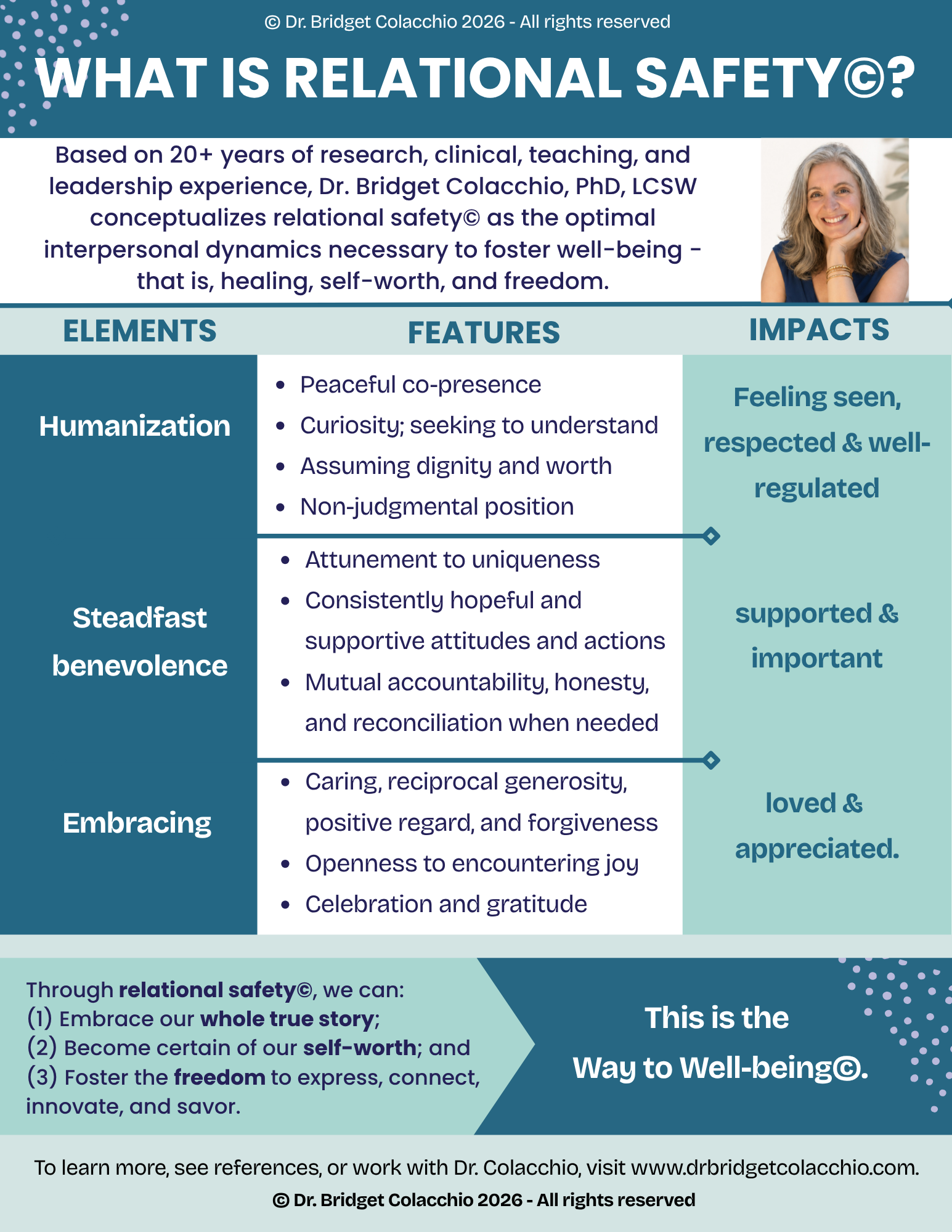
A core theme of the Way to Well-being©, relational safety©, describes the optimal aim of relationships, where people are humanized, supported, and embraced.
-
Relational safety© is a key ingredient of well-being. It describes the conditions of interpersonal relationships that allow a person to feel seen, respected, supported, important, loved and appreciated.
-
In this innovative podcast experience, co-hosts Dr. Colacchio and Nick Davis, start out as acquaintances. By creating relational safety© with and for one another, they explore various topics as they model how to forge a deeply open and respectful relationship.
Listen to the “All We Know is Where We Are” podcast on Spotify
-
Read about a pre-cursor to relational safety: Steadfast benevolence.
Co-authors: Julia Pryce, Johanna Barry, and Philip Young P. Hong
-
Coming soon in 2026.
Values-based leadership
-
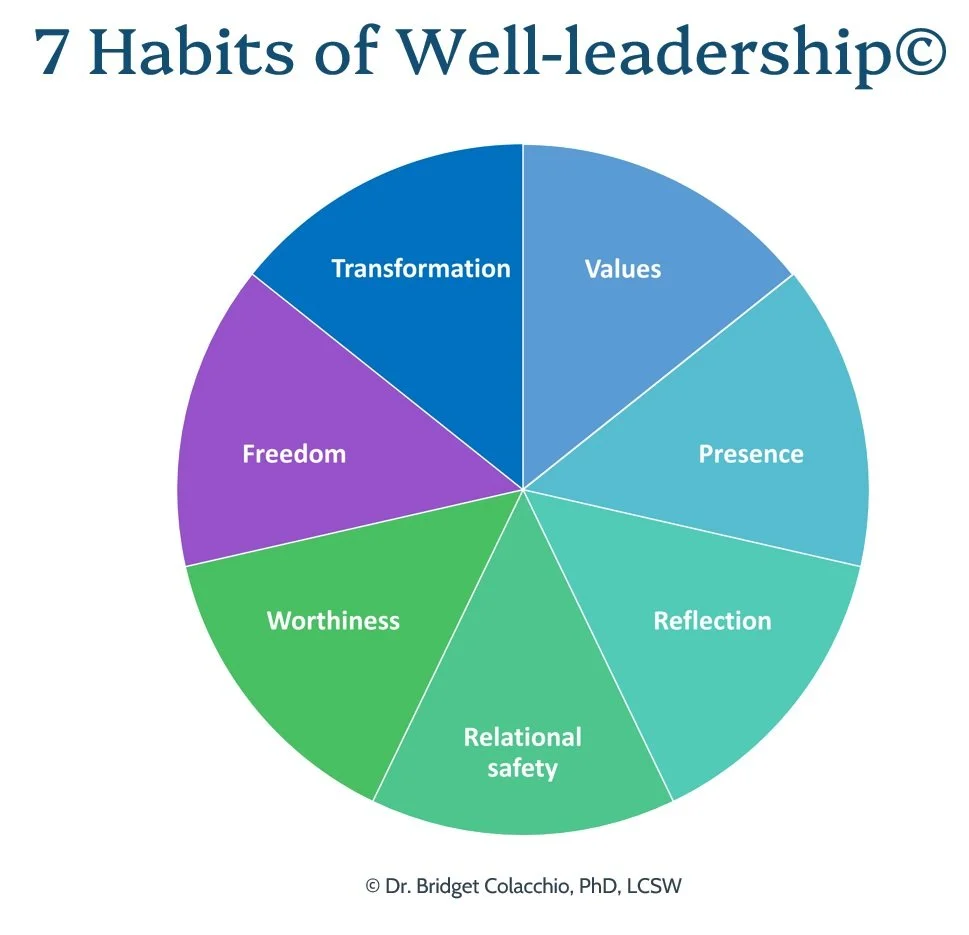
The 7 Habits of Well-leadership© was developed to translate the comprehensive findings from Dr. Colacchio’s well-being research, teaching, clinical work, and leadership experience. The model (and accompanying skills and practices) represent the distillation of the central themes and lessons and apply those to leadership behaviors.
-
To ground our teaching and leadership in values, my colleagues and I created a holistic framework to guide work in pedagogy and beyond. Read the article on The Loyola Way.
-
Listen to a limited series podcast about values-based teaching and learning.
Co-hosted by Dr. Polina Pine.